BEng Biomedical Engineering
2 Yrs KCIC → ✈️ 2 Yrs Abroad → Work Experience
Duration of the Course
Study in India
2 Yrs
Study Abroad
2 Yrs
Program Overview
Delivered in collaboration with Ulster University — and recognised by several additional universities across the UK — this program offers a structured international transfer pathway towards a globally recognised Bachelor's degree in Biomedical Engineering.
The pathway begins with a question worth considering: why pay a full first-year international fee abroad when much of that year revisits Grade 12 concepts and foundational modules? KCIC addresses this by delivering the first one or two years in India, allowing students to transfer abroad for Year 3 and Year 4 — reducing overall program cost by up to 60% without compromising the final degree outcome.
The first year at KCIC is uniquely flexible, with students studying common engineering subjects. In the second year, they select their specialisation, destination, and university.
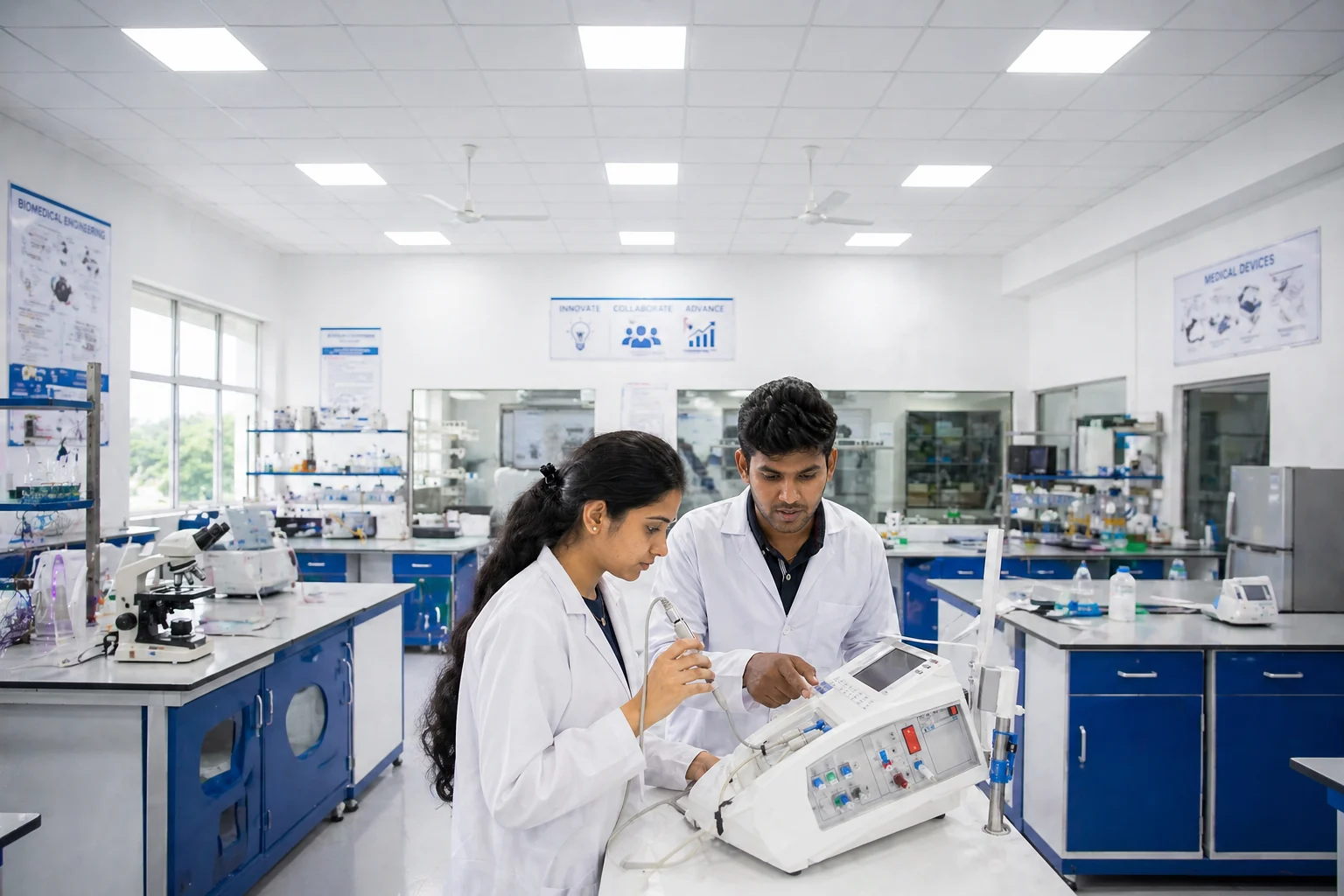
The learning model is deliberate. Theoretical foundations are taught in India, while hands-on laboratory work — including medical device testing, biomaterials, and clinical simulation — takes place abroad.
Ulster's BEng (Hons) Biomedical Engineering is accredited by the Institution of Mechanical Engineers (IMechE) on behalf of the Engineering Council, a Washington Accord signatory since 1989 — ensuring full professional mobility for graduates globally.
Further studies / Careers
After completing Year 1 – Pearson BTEC Higher National Certificate (HNC), UK Level 4 – or Year 2 – Pearson BTEC Higher National Diploma (HND), UK Level 5, eligible students can progress with advanced standing into the later stages of a relevant Bachelor’s degree in Biomedical Engineering, depending on the approved progression arrangement, university requirements and programme availability. For students progressing to the United Kingdom, options include Ulster University for the BEng (Hons) Biomedical Engineering. The programme develops knowledge and skills in areas such as medical device design, biomaterials, biomechanics, bioinstrumentation, clinical engineering and healthcare technology. After completing the BEng, graduates can pursue careers in the biomedical and healthcare technology sector, including Biomedical Engineer, Medical Device Design Engineer, Clinical Engineer, Biomechanics Engineer, R&D Engineer (MedTech) and Regulatory Affairs Engineer. Career opportunities may be available across medical device companies, hospitals, research laboratories and healthcare technology organisations. Students may also pursue postgraduate study through a Master’s/MSc in areas such as Medical Devices, Biomaterials and Clinical Engineering. High-performing graduates with an integrated research component may also be eligible to apply for PhD study, subject to university and programme requirements. Students are not limited to these pathways and may explore further study or career opportunities internationally, subject to the receiving university’s assessment of qualifications, academic performance, entry requirements and programme availability.
Entry Criteria
Grade 12: Must have 70% in Maths and Biology (or) A levels (or) IB Min 70th Percentile. English Language Requirement: 70% in English subject (or) IELTS 6.5 (Each band not less than 6.0)
Study Journey from KCIC to Study Abroad
You'll build strong biomedical engineering foundations alongside industry-relevant technical skills, developing core capabilities in engineering mathematics, anatomy and physiology, electronics, and design. The programme builds CAD fluency, circuit analysis, and structured problem-solving — using industry-standard tools such as AutoCAD, SolidWorks, MATLAB, Multisim, and Arduino — preparing you to operate effectively in modern, technology-driven healthcare engineering environments.
Progress into advanced, industry-aligned biomedical study. The programme deepens expertise across medical device design, biomaterials, biomechanics, bioinstrumentation, and regulatory affairs. Students apply engineering principles to complex clinical problems and build the critical evaluation, decision-making, and design skills needed to transition into Year 3 abroad — where hands-on laboratory work, medical device testing, and clinical application take centre stage
Based on your chosen pathway, you transfer to Ulster University as a cohort, ensuring a supported transition with familiar peers and consistent academic progression. Year 3 is a compulsory industrial placement — shifting learning from theory to application, with access to clinical environments, medical device facilities, and biomedical research labs — building real-world expertise at the stage when it matters most.
In your final year, you undertake major capstone projects, research-led design, and clinical-embedded work, applying biomedical engineering principles to real-world healthcare challenges across medical devices, prosthetics, biomaterials, and bioinstrumentation. You work with industry-standard platforms such as SolidWorks, MATLAB, LabVIEW, and ANSYS — building the expertise expected of graduate biomedical engineers entering global healthcare industry.
Upon graduation, students receive a full international degree and are eligible for an 18–24 month post-study work visa, allowing them to stay and seek employment. This visa permits full-time work and does not require employer sponsorship.
Accreditation
Biomedical Engineering degrees from Ulster University are recognised in India by the National Board of Accreditation (NBA) under the Washington Accord, where India has been a permanent signatory since 2014. Ulster's BEng (Hons) Biomedical Engineering is accredited by the Institution of Mechanical Engineers (IMechE) and the UK Engineering Council — both founding Accord signatories since 1989 — giving you a qualification respected across 25 signatory nations including the United Kingdom, United States, Australia, Canada, New Zealand, Singapore, Japan, and Ireland.
Exemptions
On completion of the BEng (Hons) Biomedical Engineering at Ulster University, graduates may apply for professional membership with recognised engineering bodies such as the Institution of Mechanical Engineers (IMechE), the Institution of Engineering and Technology (IET), and the Engineering Council, UK. Membership supports registration as an Incorporated Engineer (IEng) or progression towards Chartered Engineer (CEng) status — providing globally recognised professional standing across Washington Accord signatory nations.
Industry Collaboration
The first two years of this qualification are designed in collaboration with global biomedical and healthcare industry leaders. The curriculum is shaped by input from medical device manufacturers and healthcare organisations — alongside IIT partners, the Institution of Mechanical Engineers (IMechE), and Fortune Global 500 leaders including Siemens Healthineers (medical imaging), Philips (healthcare technology), Medtronic (medical devices), Johnson & Johnson (surgical systems), Stryker (orthopaedics), Abbott (diagnostics), Boston Scientific (interventional medicine), and Randox (diagnostics and life sciences) — ensuring graduates are career-ready for the global biomedical industry.
Career Outcomes & Employability
Graduate employment statistics for BEng Biomedical Engineering
Job Placement Rate
Above Industry Average
₹38 - ₹46 LPA
Average Starting Salary
Career Pathways & Salaries
Biomedical Engineer
£27,000 – £55,000
Medical Device Design Engineer
£30,000 – £60,000
Clinical Engineer (NHS)
£27,000 – £45,000
Biomechanics Engineer
£28,000 – £52,000
R&D Engineer (MedTech
£35,000 – £65,000
Regulatory Affairs Engineer
£32,000 – £60,000
Quick Info
Stage 1 Study in KCIC
Intake & Application Deadlines
Apply before: Aug 31, 2026
KCIC Tuition Fees
₹375,000/Yr
💳 Pay in EMI ₹67,500 x 6 months
Study Abroad Tuition Fee
GBP 14,500*
*Subject to change
Collateral-free loans availableFlexible payment optionsPotential part-time earning upto 12 Lacs while studying abroadOption to include paid placement year, earn upto 19 lacs between the academic years abroad
Frequently Asked Questions
Find answers to common questions about this qualification