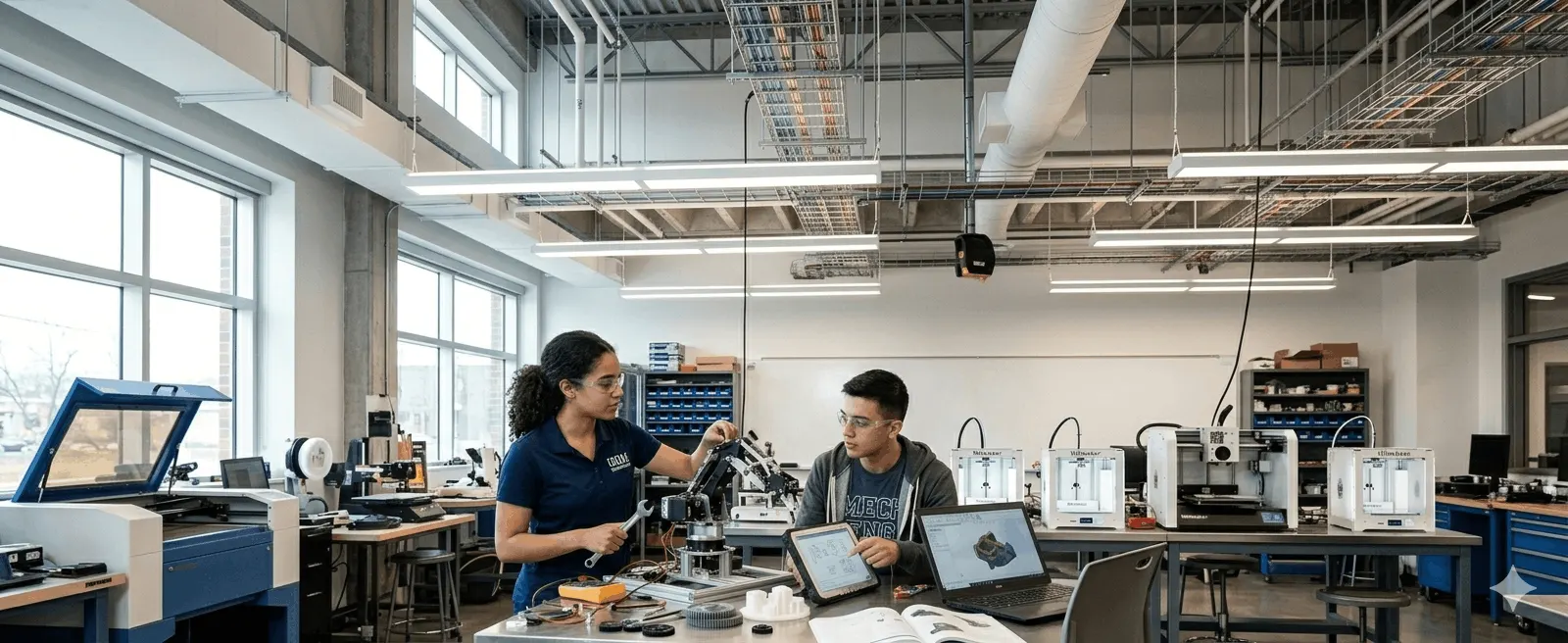
School of Engineering
Creating Engineers to Bridge the Skills Gap
Duration of the Course
Study in India
2 Yrs Diploma
Study Abroad
2 Yrs Bachelor's Conversion
Program Overview
Start in Chennai. Build international skills. Progress overseas. Prepare for a global engineering career with KCIC.
Engineering careers are changing rapidly. In India, thousands of talented graduates compete for the same entry-level opportunities, while countries such as Australia and the UK continue to invest in infrastructure, renewable energy, automation, transport and advanced manufacturing. For students, the question is no longer simply, “Which engineering degree should I study?” It is, “Which engineering skills will the world need when I graduate?”
At KCIC School of Engineering, students can begin with a two-year international engineering diploma in Chennai and progress, subject to one of our partner or network university with credit transfer system, towards completing an engineering degree in Australia, Europe or the UK.
The focus is on future-facing areas including Power Systems, Renewable Energy, High-Voltage Engineering, Civil Infrastructure, SCADA and Control Systems, Mechatronics, Automation, Rail Signalling, Embedded Systems, IoT and Telecommunications. This pathway allows students to build practical, internationally relevant skills before moving overseas. For families, it can also make international education more manageable by completing the first stage in India before progressing abroad.
Most importantly, students prepare for industries that are growing. An electrical engineer may work in renewable energy, a mechanical engineer in robotics, a civil engineer in intelligent transport, and a mechatronics graduate in automation or advanced manufacturing.
2 Years in Chennai → Progress Overseas
BTEC HND (2 Yrs) → Bachelor’s Degree Conversion (2 Yrs)
Future Skills → Renewable Energy, Automation, Robotics & Infrastructure
The future will favour engineers who understand where industries are growing and prepare early.
Further studies / Careers
After completing Year 1 – Pearson BTEC Higher National Certificate (HNC), UK Level 4 – or Year 2 – Pearson BTEC Higher National Diploma (HND), UK Level 5, eligible students can progress with advanced standing into Year 3 of a relevant Bachelor of Engineering degree, depending on the approved progression arrangement, credit transfer and entry requirements of the chosen university and programme. For students progressing overseas, the final two years normally lead to a full bachelor’s degree. In Australia, KCIC Engineering students have progression opportunities to RMIT University, the University of Technology Sydney (UTS) for relevant engineering degree pathways. In the United Kingdom, progression options include Heriot-Watt University, the University of Essex, Ulster University and Sheffield Hallam University for relevant engineering programmes. The programme also provides opportunities to progress through partner and network universities in Europe and the United States that accept BTEC HND qualifications, subject to university-specific requirements. Students are not limited to these listed destinations. After completing the two-year BTEC HND at KCIC, they may also explore credit-transfer and advanced-standing opportunities with other suitable universities, subject to the receiving university’s assessment of completed credits, curriculum compatibility, academic performance, entry requirements and programme availability. Depending on the chosen pathway, students can progress into engineering disciplines including Mechanical, Electrical, Civil, Aerospace, Mechatronics, Automative and related fields.
Entry Criteria
You must have subject specific grades - 70% in Mathematics & English at Grade 11 and/or 12 or equivalent qualifications from a recognised board.
Study Journey from KCIC to Study Abroad
Year 1 builds your engineering foundation: mathematics for engineers, applied physics, electrical and electronic principles, circuit theory, engineering materials, technical drawing and CAD, workshop practice and safety, digital electronics fundamentals, introductory programming and automation concepts, plus professional skills in communication, teamwork and project management. You'll also cover measurement and instrumentation basics and sustainability principles, giving you the grounding needed before specialising in Year 2.
Year 2 moves into specialisation: power systems and high voltage networks, renewable energy technologies, SCADA and industrial control systems, instrumentation and automation, embedded systems and IoT, telecommunications fundamentals, plus modules in rail signalling, mining automation and mechatronics, substation design, and building services electrical systems. You'll apply this through simulation labs and a capstone project, preparing you for lateral entry into the year three of a Bachelor of Engineering in Australia or the UK.
In Year 3, your standard student visa lets you work part-time, same as every other international student. The difference is what you do with those hours. Students holding only a Year 12 certificate typically work retail or hospitality shifts. Your recognised diploma qualifies you for part-time roles directly in your chosen field, power systems, renewable energy, SCADA or automation, turning the same visa allowance into real industry experience, income and professional contacts before you've even graduated.
In your final year, you undertake major capstone projects, research-led design, and industry-embedded placements, applying engineering principles to real-world challenges across aerospace, robotics, AI-driven systems, and automotive engineering. You work with industry-standard platforms such as ANSYS, CATIA, SolidWorks Simulation, LabVIEW, Siemens NX, and MATLAB Simulink — building the expertise expected of graduate engineers entering global industry.
You will graduate with a full international bachelor’s degree, receiving the same qualification as students who complete the entire programme overseas. Depending on your study destination and current immigration regulations, you may also qualify for an 18–24-month post-study work visa, allowing you to remain in the country, seek employment and work full-time without employer sponsorship.
Accreditation
The BTEC Higher National Diploma (HND) in Engineering is a UK Level 5 qualification, broadly comparable to the first two years of a bachelor’s degree. It is regulated by Ofqual – the Office of Qualifications and Examinations Regulation – and widely recognised by universities, professional bodies and employers across 100+ countries, supporting international progression and career opportunities.
Exemptions
BTEC Higher National Diploma (HND) students at KCIC receive up to two years of advanced standing exemption at eligible partner universities and universities within the wider Pearson progression network worldwide, allowing them to enter directly into year 3 of a related bachelor’s degree, subject to university-specific entry and credit requirements.
Industry Collaboration
The first two years at KCIC are delivered through the Pearson BTEC Higher National Diploma (HND) in Engineering, a UK qualification regulated by Ofqual. Pearson is the global education company behind Pearson Edexcel, the awarding body for internationally recognised qualifications including International GCSEs and International A Levels. The HND curriculum is developed with input from leading employers, industry bodies and academic institutions including Siemens, ABB, BMW, McLaren, Airbus, Emirates, BAE Systems, Network Rail, IIT Jodhpur and IIT Tirupati, helping align learning with emerging technologies and critical engineering skills shortages. For Indian students, this combines academic knowledge, practical engineering skills and international industry relevance, while also creating pathways for advanced entry into eligible engineering degrees overseas.
Career Outcomes & Employability
Graduate employment statistics for School of Engineering
Job Placement Rate
Above Industry Average
£42000
Average Starting Salary
Career Pathways & Salaries
Mechanical Engineer
£35,000 - £55,000
Electrical Engineer
£34,000 - £52,000
Automation Engineer
£47,000–£60,000
Manufacturing
£32,000 - £38,000
Quick Info
Stage 1 Study in KCIC
Intake & Application Deadlines
Apply before: Aug 31, 2026
KCIC Tuition Fees
₹375,000/Yr
💳 Pay in EMI ₹67,500 x 6 months
Study Abroad Tuition Fee
£14,500*
*Subject to change
Collateral-free loans availableFlexible payment optionsPotential part-time earning upto 12 Lacs while studying abroadOption to include paid placement year, earn upto 19 lacs between the academic years abroad
Questions? Our counsellors reply within 60 minutes.
Stage 2 Transfer Options
Hear From Our Students
Real stories from students who have taken this path.

Chris Jordan Clifford
RMIT University, Australia
School of Engineering
"Ambition found its direction at KCIC. Through the transfer programme, I built a strong academic foundation before moving to RMIT University in Australia to pursue my Bachelor of Engineering in Mechanical Engineering. KCIC was more than a starting point — it was the launchpad to my international future."

Twisha Sharma
Oxford Brookes University, UK
School of Engineering
"A world-class career begins with purposeful preparation. Through the HND pathway at KCIC, I gained practical, industry-focused expertise that enabled my seamless transfer to Oxford Brookes University. That strong academic and applied foundation prepared me for elite engineering environments, including experience with the Mercedes-AMG PETRONAS Formula One Team. KCIC was the catalyst that transformed ambition into global opportunity."

Rajesh Deekonda
Ulster University, UK
School of Engineering
"KCIC provided the map, and Ulster University provided the destination. Today, as a Mechatronic Engineer at Sensata Technologies, UK, I look back at the KCIC transfer programme as the defining moment of my career. It was more than a degree—it was the continued guidance and the perfect pathway to where I am today"
Ravi Teja Reddy
RMIT University, Australia
School of Engineering
"KCIC built the runway, and RMIT University gave me the skies to soar. I began my Aerospace Engineering journey at KCIC, where strong academics and close mentorship prepared me for global success. With seamless transfer support, I progressed to RMIT University in Australia and completed my degree with confidence. KCIC was more than a starting point — it was the launchpad to my international future."
Chris Jordan Clifford
RMIT University, Australia
School of Engineering
"Ambition found its direction at KCIC. Through the transfer programme, I built a strong academic foundation before moving to RMIT University in Australia to pursue my Bachelor of Engineering in Mechanical Engineering. KCIC was more than a starting point — it was the launchpad to my international future."
Twisha Sharma
Oxford Brookes University, UK
School of Engineering
"A world-class career begins with purposeful preparation. Through the HND pathway at KCIC, I gained practical, industry-focused expertise that enabled my seamless transfer to Oxford Brookes University. That strong academic and applied foundation prepared me for elite engineering environments, including experience with the Mercedes-AMG PETRONAS Formula One Team. KCIC was the catalyst that transformed ambition into global opportunity."
Rajesh Deekonda
Ulster University, UK
School of Engineering
"KCIC provided the map, and Ulster University provided the destination. Today, as a Mechatronic Engineer at Sensata Technologies, UK, I look back at the KCIC transfer programme as the defining moment of my career. It was more than a degree—it was the continued guidance and the perfect pathway to where I am today"
Ravi Teja Reddy
RMIT University, Australia
School of Engineering
"KCIC built the runway, and RMIT University gave me the skies to soar. I began my Aerospace Engineering journey at KCIC, where strong academics and close mentorship prepared me for global success. With seamless transfer support, I progressed to RMIT University in Australia and completed my degree with confidence. KCIC was more than a starting point — it was the launchpad to my international future."
Direct Final Year Options
Universities where you can complete your degree in the final year(s)
Swipe
Frequently Asked Questions
Find answers to common questions about this qualification